


If you're looking at university applications for an IB student, you've probably come across the term "predicted grade" and wondered how a number assigned months before final exams can carry so much weight. The short answer is that it fills a timing gap universities can't avoid - but the mechanics behind it are important for students and families to understand.
What is a predicted grade?
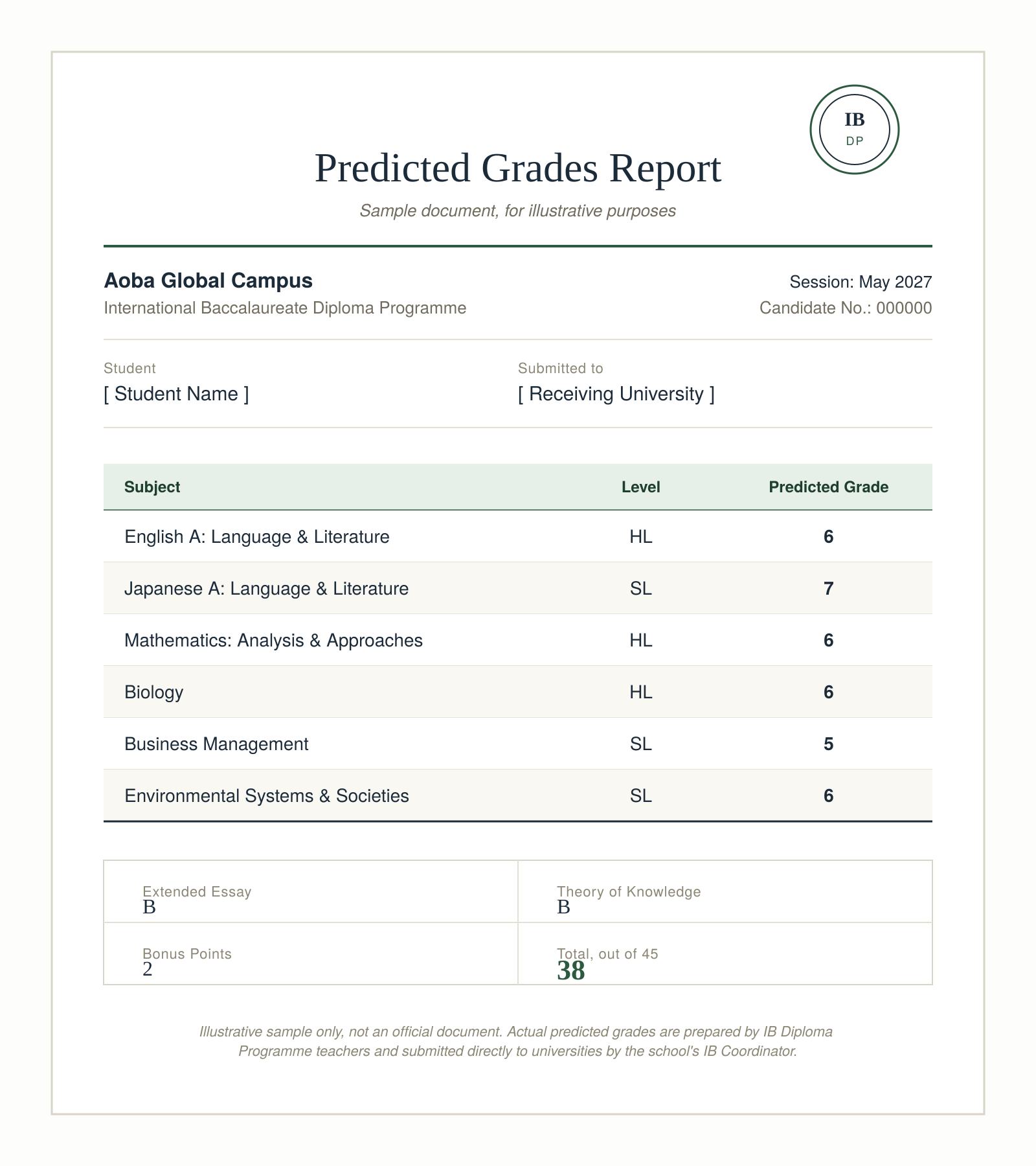
A predicted grade is a teacher's estimate of the final score a student will achieve in each subject, on the IB's 1-7 scale, plus a projection for the up to 3 additional points from the Extended Essay and Theory of Knowledge. Together these produce a predicted total on the same 45-point scale the final diploma uses. (CAS - Creativity, Activity, Service - is the third core component of the Diploma alongside EE and TOK. It's required for the diploma to be awarded but isn't scored, so it doesn't appear on a predicted grades report.)
Teachers arrive at these numbers using two years of evidence: internal assessment scores, mock exam results, coursework trends, and classroom performance, measured against the IB's published grade descriptors for that subject. The exercise is the same for every teacher and every subject - estimate where the evidence points, not where you'd like the student to land.
How are predicted grades calculated?
Subject teachers submit predicted grades in the final year of the programme, typically in the fall and winter before the May exam session. Most schools run internal moderation before submission: department heads or the DP Coordinator check that predictions are consistent and well-calibrated across the cohort, not just individually defensible.
Once finalized, the grades go into IBIS, the IB's information system, and are released to the universities a student has applied to.Predicted grades are generated before the exams that actually determine the diploma. That's the reason they exist at all.
Why do universities need predicted grades?
Final IB results aren't published until early July, well after most application deadlines close. Universities need something to evaluate applicants against before then, and predicted grades are that something.
In the UK, this runs through UCAS: applicants typically receive a conditional offer based on predicted grades - for example, 38 points including a 6 in Higher Level Biology - which becomes unconditional once actual results confirm or exceed the prediction. In the US, predicted grades feed into early decision and early action review and scholarship consideration, though final admission decisions are rarely conditioned on them the way UK offers are. Canada, Australia, and most of Europe work on broadly the same conditional-offer logic.
Japan works on a similar principle, though the process often looks a little different on paper. A number of Japanese universities - among them International Christian University, Sophia University, and Meiji University - run IB-specific admissions pathways that have a school's IB coordinator submit a predicted grades report directly to the university, separate from the general application track. These routes typically weigh the IB score alongside an essay and interview, in the same comprehensive-review spirit as Japan's AO and returnee-student entrance exams, and national education policy has actively encouraged universities to expand this kind of IB-based selection over the past decade.
Across the rest of the Asia-Pacific region, the logic tracks closer to the UK model. Hong Kong's government-funded universities admit IB diploma holders through a non-local qualifications route that sits alongside the main JUPAS system used for local applicants, and conditional offers built on predicted grades - a place secured now, confirmed once final results meet the stated terms - are the norm across most of the region's leading universities, much as they are in the UK and Australia.
Research on IB predicted grades consistently finds a tendency to over-predict, especially at the higher end of the scale. Admissions offices know this and account for it when reading applications. A prediction that's honest and well-evidenced serves a student better than one that's simply generous - which is exactly why the internal moderation step matters.
What does this mean for students and families?
Predicted grades matter earlier than final grades do. For anyone applying to university during the second year of the DP, predictions are what most offers are actually built on. They're also not fixed the moment a teacher writes them down. Because they're built from two years of evidence, consistent performance across IAs, mocks, and coursework throughout the programme matters more than any single exam week. Students and families can ask teachers what a prediction is based on and where there's room to move it before submission - that conversation is normal, not adversarial. And a predicted grade sets a starting point for the offer conversation; plenty of students go on to outperform it in the actual exams.
Where this fits at Aoba Global Campus
Because predicted grades depend on two years of cumulative evidence, they're only as reliable as the relationship between a teacher and a student over that time. In an Online IBDP, our goal is to maintain the kind of ongoing, subject-by-subject visibility into a student's work that a strong prediction requires, regardless of physical distance. At Aoba Global Campus, goal shapes how we run the programme - consistent teacher contact, regular feedback, and close tracking of IA and coursework.
If you're thinking through IB subject selection or want to understand how predicted grades might shape your child's university options, our team is happy to talk it through.